



So, what does eco-design actually mean? Eco-friendly, eco-responsible, green, sustainable, organic, vegan, recycled, recyclable… it's a real minefield. These days, to avoid greenwashing, some of these words have become almost unusable. They've been thrown around so much they've lost all meaning. And if you do use them, you'd better be able to back them up.
Is an organic cotton bag more eco-responsible than a nylon one? The first answer that comes to mind is absolutely yes, because "cotton" sounds natural and "organic" sounds clean… but when you actually dig into the full picture, it's not that straightforward. We'll do our best to explain how we define "eco-design" without losing you along the way.
The most sustainable product is the one that never has to be produced.
Obviously. But if you genuinely need a backpack and you've decided to buy new (secondhand is always worth a thought, just putting it out there), someone's got to make it, whether that's you, your gran, or a manufacturer like us.
And here's the thing: every single stage of a product's life, from design to disposal, has a direct or indirect impact on the environment, and therefore on people and nature. To produce is to use resources. To use resources is to have an impact. There's no way around it.
It’s up to both you, the consumer, AND us, the manufacturer, to keep that impact as small as possible. Eco-design, in our view, is designing a product in such a way as to minimise its negative impact on the planet.
We need to optimise each stage of the product life cycle.
When we started out, we didn't have the resources to do much beyond talking openly about what we were doing, with full transparency and, above all, common sense. Today, rather than waiting for regulations to force our hand, we're moving forward step by step, with audits that let us actually demonstrate what we're doing. Not just for traceability, but for ourselves too, so we can better understand our impact and keep improving.
And here's something we really believe: you don’t need a degree in sustainability to design responsibly. You just need common sense. Understand the impact each stage of your product's lifecycle will have on the environment, and the rest is about finding the right balance. Because let's be honest, for a brand to exist, grow, hire people, and create real value, it needs to make money. If we produced the most eco-responsible bag on the market but had to price it so high that nobody could buy it… we'd have done it all for nothing. And we know a thing or two about that 😅.
We're not going to claim we make the "best" backpack on the market (plenty of others do that already). What we do is try our best to reduce our environmental footprint, using the resources we have available. So here's our attempt to walk you through it, step by step, with complete transparency.
Here are the stages in the life cycle of a MeroMero backpack:


NEED.
Before anything else, we always ask ourselves whether it's actually useful to create and produce the thing we have in mind. Do we really need it? Is it worth using resources, having an impact, even a small one, for a product nobody really needs and that serves no real purpose? Obviously not. So before we start designing anything, we ask our community, our customers, you, what you actually need. That might be an online questionnaire, a workshop in Annecy, or a vote on Instagram. For us, this is where the eco-design process truly begins.
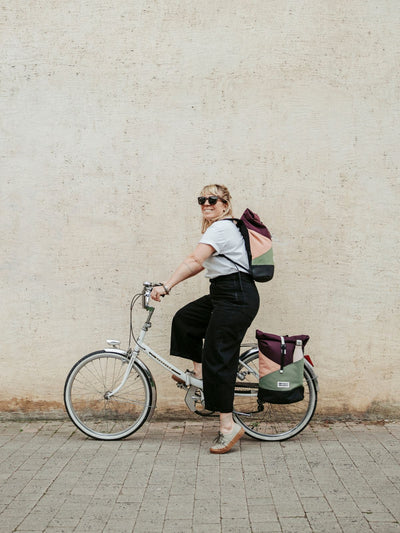
The ANNECY (formerly the MINI-SQUAMISH) wasn't even on our radar. But when we asked our customers how we could improve the Squamish, the answer came back loud and clear: "a smaller version we could fix to a bike." So we listened to you, we developed it and it even won the French Outdoor Award 2020 at the ISPO Munich trade show as well as the Favorite by OSV award at the Vélo Vert Bike Festival.

Design.
Once we know what's needed, we start shaping the idea. And from the very first sketches of what will eventually become a product, we have to keep the entire lifecycle in mind, finding the best solutions to limit its footprint throughout its entire lifecycle. It's honestly one of the most exciting parts of the process. Especially now that we have data from our Life Cycle Assessments and Carbon Footprint assessments to actually inform our decisions.
Design is that moment when the idea in your head takes shape on paper, and then on screen. It's when you have to think about everything at once: style, materials, manufacturing, all the different ways a product might be used (including uses we never intended), how it will be shipped, sold, used, repaired and eventually recycled... all while keeping an eye on price, profit margins, time, and environmental impact. And we genuinely believe you should be part of this process. After all, you're the one who's going to use it. That's why we regularly run collaborative workshops, to hear your needs and ideas, and to build the products of tomorrow together.

materials.
This is a complex one, because each material needs to be looked at in context, as part of the finished product. And everything counts: where the raw materials come from and how they're extracted, the weaving, the dyeing, the transport, and at every stage, the same questions keep coming back. What's the impact on people? What's the impact on the environment? We're talking about material quality and processing, chemical use, water consumption and waste treatment, energy, working conditions, transport to the factory...
Do we have full control over the entire chain? Honestly, no. Not at our scale. But what we do is demand certifications and compliance with recognised standards (OEKO-TEX, Bluesign...), work closely with trusted suppliers, test their products independently (with SGS), visit them in person and visit their factories. None of which makes much sense unless your suppliers are close to where you actually manufacture, which is why we've been deliberate about that.
In practice: our fabrics come primarily from Korea. Metal buckles, YKK zippers and leather come from Vietnamese suppliers, close to our factory in Ho Chi Minh City. And other components like cords, magnets and velcro come from Vietnam where possible, or China when necessary.

Production.
The place of manufacture speaks to everyone. But it's often worth digging a little deeper and not stopping at a simple "made in...". Something can be made in Europe under deplorable conditions, or in China in an ultra-modern factory. It all depends on what you're making. A T-shirt or something simple can come from France or Portugal, shoes or leather goods from Italy. For technical items like backpacks, however, which require specialist materials and skilled labour, Vietnam is often the place to be.
After first trying France and then Slovakia (and almost bankrupting the company in the process), MeroMero bags and accessories are manufactured in Vietnam, north of Ho Chi Minh City, with a Japanese partner who specialises in technical products: paragliding harnesses and wings, climbing harnesses, backpacks... We've worked with them since 2018, on an almost daily basis, and travel there once a year.
Yes, labour is cheaper than in France. But the two are simply not comparable. And rest assured: no children work there, only highly trained and qualified staff. Oh, and they're wonderful people, too.
Working with the same partners over several years also means we can manage the entire manufacturing process from end to end: prototyping, materials, cutting, assembly, finishing, delivery... And in the spirit of full transparency, we'll explain in detail exactly how and why we believe it's possible to manufacture responsibly, even on the other side of the world.

Shipping.
Manufacturing in Asia means shipping goods to Europe. And here too, the subject is both complex and fascinating, well worth looking at properly. Did you know that travelling 2,000 km by truck (say, from Annecy to the south of Portugal, or even further to Romania) emits as much greenhouse gas as 15,000 km on a cargo ship coming from Asia? (We're still digging into this one, but the figures are striking.) Our recent Carbon Footprint assessment confirmed that transportation from Asia (scope 3) represents less than 1% of our total emissions. For now, we've had to make compromises and go with the least bad option to get our goods home.
The factory we work with sits north of Ho Chi Minh City, in the southern half of Vietnam, very close to the port. Our products spend over two months at sea on a cargo ship. Once the shipment arrives at Fos-sur-Mer in the south of France and clears customs, the container travels by truck to Annecy, where everything is stored.
We use air freight for prototypes and sales samples via DHL. Sometimes we send a few boxes via cargo plane to meet the demands of certain retailers who require ever-earlier delivery. It's a temporary solution until the ship arrives.
Rail freight would be an interesting alternative, but the line only runs from China. Which would mean trucking all the way up through Vietnam and part of China to catch a train to northern Germany, then trucking back down to Annecy. Hardly environmentally friendly. And that's exactly the point: everything has to be considered in full, not just the headline figure.

Logistics.
We work with a local logistics centre on the outskirts of Annecy, just a few kilometres from our office. BJ Logistics has been based in the Greater Annecy area since 2013 and employs nearly 30 people, a few more during busy periods. On top of being extremely reliable and attentive to our needs, they constantly review their processes to find ways to reduce their environmental impact. They've recently put in place a proper CSR (Corporate Social Responsibility) policy, which is very much in line with our own values.
Where possible and with the customer's agreement, they reuse boxes, cut down on plastic wrapping and swap traditional tape for kraft tape. They also work to reduce CO2 emissions by choosing the right shipping partners, and have broader initiatives around responsible purchasing, energy consumption, waste reduction, going paperless, and process innovation.
On our end, we're working on reducing the amount of plastic used to protect our products. It's a tricky one, because plastic does play a key role in protecting against moisture and mould during shipping. One option would be to use a single bag per box rather than per product, but that would mean repacking everything at the warehouse before sending your order out. To be continued…

Communication.
Here, too, it is possible to act responsibly. The subject is vast and the tools are many, so we try to apply the same common sense approach every time we look at our environmental impact.
We've cut back significantly on printed materials and have almost completely phased them out: catalogues, stickers, flyers and the like. When we do need to print something, we use recycled paper and vegetable-based ink, for business cards, product labels and so on. We also reuse whatever we can: the logos cut from boxes, for instance, get turned into point-of-sale displays for events and shops. All our trade show furniture is made from recycled pallet wood, and the decor is either vintage or borrowed.
We keep our newsletters to a minimum and encourage subscribers to delete them from their server once read. We work primarily with French suppliers and collaborators: website host, webmaster, photographers and so on. We try to limit travel to events and shops, taking the train whenever we can avoid flying. Even our retailers and ambassadors share our values. And there is still plenty of room for improvement!

sales.
This step is crucial because selling our products (in other words, the revenue generated from your purchases) allows us to generate enough revenue to finance creation and innovation, create jobs (even with freelancers), and invest in the future. Our goal is not to generate astronomical profits in the hopes of a future IPO (otherwise, we’d probably have chosen a different business!), but to allow us to create products that you will actually use, to manufacture goods as responsibly as possible, to show future generations that value can be created and shared, that it is possible, even essential, to consume and therefore to do "business" while respecting the environment.
We decided to make compromises (as often in eco-design) to find a balance between our values and the need to grow. We are lucky enough to have established long-term relationships with agents, distributors (for export to other countries), and dealers who share the same values as us, respect prices and customers. And above all, we are lucky to find resellers who take risks by selecting small "different" brands. We often turn down opportunities that don't correspond to our values.
We recently updated our Terms and Conditions to include a commitment to upholding our values. We also refer to a charter that must be signed by our retailers in order to distribute our products. Increasingly, it is even our resellers themselves (especially those in Germany) who are asking brands to demonstrate their commitments regarding carbon footprints or other environmental initiatives.
In addition, we donate 1% of our annual revenue to non-profit organisations dedicated to environmental protection through the 1% FOR THE PLANET network. This is an initiative we have fully supported from the very beginning. And it's a strong commitment, because we will always continue to make this donation, even in years when we incur losses!

Use.
Only by looking at the overall footprint does one realise to what extent the use of a product has a considerable impact on the environment. The challenge is that some brands see their responsibility as ending at the point of sale. We see it more as passing the baton from one organisation to another, or even as a mutual commitment between the brands that design and manufacture, and the customers who buy and use.
Yes, customers have their role to play in the way they use a product, but we can't stop them from washing a T-shirt because it smells, ironing it because the fabric wrinkles, ditching it because it's not practical or poorly cut, or throwing it away because it's ripped, full of holes, or broken beyond use. This is why, before ever launching a product and consuming resources (even in limited quantities), we need to consider not only how it will be used, but also care and maintenance, repair, and end of life (more on that later).
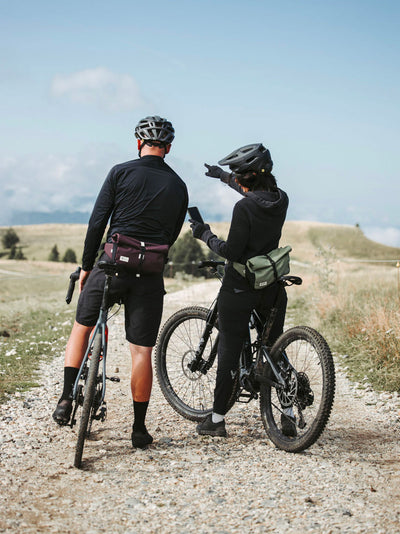
This is actually one of the most exciting parts of product design: imagining it in the hands and in the life of its future owner. For our bags, we try to plan for every possible use, intended or not, by a parent, a photographer, a backpacker, a cyclist, a traveller heading to the ends of the earth... those who look after their things, and those who will throw the bag on the ground or grab it by a strap that was never "supposed to be used" that way.
This is also why all our products are modular and adaptable. We planned for our changing mat to be reused as a laptop sleeve, the insulated pocket to double as a camera lens case, and our stroller attachments to be used as key rings... and so on.
This is also why we ask for your feedback, find out about your lifestyle, listen to your comments, and run workshops to co-create with you the products you actually need. We also work closely with our ambassadors (our heroes) to develop products they'll use every day, now and for years to come.

Care & Maintenance.
Cleaning and maintenance for a bag makes much less of an impact than for a garment, but washing any textile product still pollutes: laundry detergent, wastewater, microfibres, drying, ironing. Here too, we can plan for how the bag will be cared for and find solutions to design a product that is easy to maintain.
This is why, after making our waxed cotton bags (coated), which were stylish and good looking but showed the dirt easily and weren't very UV resistant, we now use weather-resistant 100% recycled nylon (bluesign certified), which is easier to clean and doesn't need cleaning nearly as often. The changing mat has a waterproof and removable pad (made with Tencel®) to avoid having to put the entire mattress it in the washing machine after every use, especially when you want to use it as a laptop sleeve afterwards.
Our role is also to advise customers on how to care for their bags and accessories. So please do share your feedback on how you look after your products. That way, we can make improvements from one version to the next.

Repair.
Even though we do our best to make quality products, sometimes a seam comes loose or a loop breaks. It's one of our greatest fears, but it does happen, even to the best of us. Beyond any defects that may show up, no one is immune to an accident or catching their bag on something sharp. So, to make sure our bags last as long as possible, we work with repair centres such as GoodLoop and Greenwolf in France, and soon United Repair in the Netherlands for the rest of Europe (but we don't have enough repairs yet!). They are all specialists in repairing outdoor soft goods (clothing, bags, etc.) and work with top brands such as Patagonia, Norrona, Picture...
Although we ultimately have very few repairs or returns, we have entrusted them with managing all customer and after-sales service. So if your bag has a manufacturing defect, don't hesitate to get in touch with us (or your local retailer). You have a two-year legal warranty (including Velcro and zippers). And since we receive very few returns, we've extended the warranty to 10 years (excluding Velcro and zippers, as any defects would have appeared before then). In this case, or if your bag simply needs a repair that isn't our fault, we can still find a solution, both technical and financial, to encourage the repair of our products and extend their lifespan as much as possible. We'll make sure the repair centre takes good care of your product so it comes back looking as good as new.
Once repaired, sewn up, patched up and pampered, your bag will either be sent back to you or sold second hand at a bargain price. More or less reconditioned, but with a few small scars, marks that tell the story of where it's been. It's down to us, the brands, to offer this kind of service. But it's also down to you, the customer, to think about repairing your product before throwing it away or recycling it.

Recycling.
Once your bag has truly reached the end of its life and can no longer be repaired, the next step is to recycle it. But even today, as absurd as it may seem, the process for recycling backpacks isn’t fully developed yet. So while we wait for organizations (which we pay a lot of money to!) and governments to come up with solutions, we’re doing our best to repair them and prepare for future recycling.
So thinking about future recycling, we take this final stage of a product's life cycle into consideration during the design process, as if to close the loop. It's important for us to understand how the entire fibre recycling process works. For example, today we are still unable to recycle nylon-polyester blends, or nylon bonded to a waterproof-breathable membrane. To recycle them, they need to be separated, but since it's either too complicated or next to impossible, products with this composition end up in the incinerator. This is why we made the conscious decision to use nylon as the main material for our bags, for almost all reinforcements and linings. It's an extremely durable, abrasion-resistant fibre, and just as importantly, nylon is both recycled and recyclable.
The rest (straps and buckles) are easy to cut off. We chose buckles made from aluminium, a tough, very light alloy that can be recycled again and again (and again...). We'd also like the small amount of plastic we use to be recycled and recyclable as well.
And speaking of closing the loop, at some point we'd love to be able to retrieve MeroMero bags when they reach the very end of their life, so we can manage the recycling ourselves and make sure that none of our products, even those that are no longer usable, end up thrown away. Stay tuned…
An eco-designed product, as you can see, requires an overall “cradle to grave” approach. Beyond the product or service itself, you need to take a holistic view of the problem and corresponding solutions. The environmental, social, and societal stakes should be key issues to focus on for every company and for the citizens of our planet.
The certification process is long and tedious; and unfortunately not suitable for small companies. But the audit and self-diagnostic work will allow us to get to know ourselves better and identify those areas where we want to focus our energy to improve. One thing is certain, nothing beats common sense and transparency!


